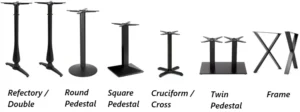
Pedestal vs Twin vs Four-Leg Table Bases
Choosing the right table base can make a significant difference to the stability, comfort and appearance of your finished table. While there are many different base designs available, three of the most popular configurations are pedestal, twin and four-leg table bases.
Each option has its own advantages and is suited to different tabletop shapes, sizes and applications.
This guide explains the differences between the three configurations to help you choose the right table base for your project.
Pedestal Table Bases
A pedestal table base provides support from a central point or central structure underneath the tabletop.
Pedestal bases are particularly popular for dining tables because they can provide excellent legroom without traditional legs positioned at the corners of the table.
Why choose a pedestal base?
Central support: A pedestal concentrates the supporting structure towards the centre of the tabletop, creating a clean and uncluttered appearance.
Good legroom: With no legs at the corners, diners have greater freedom when positioning their chairs and legs.
Suitable for many dining tables: Pedestal bases can work particularly well with round, square and some rectangular tabletops, depending on the size and design of the base.
Strong visual impact: A sculptural pedestal can become a feature of the table, particularly when paired with a simple tabletop.
When is a pedestal base suitable?
A central pedestal can be a good choice when you want to maximise the usable space around the edge of the table.
They’re particularly popular for:
- Round dining tables
- Square dining tables
- Smaller rectangular tables
- Café and restaurant tables
- Bespoke dining tables
- Contemporary furniture designs
For larger tabletops, check the manufacturer’s recommended tabletop dimensions and weight capacity before selecting a single pedestal.
Twin Table Bases
Twin table bases use two supporting bases underneath the tabletop rather than a single central pedestal.
This configuration is particularly useful for longer rectangular tabletops where additional support